
Quantitative vs. Qualitative Nursing Research: Key Differences and Examples
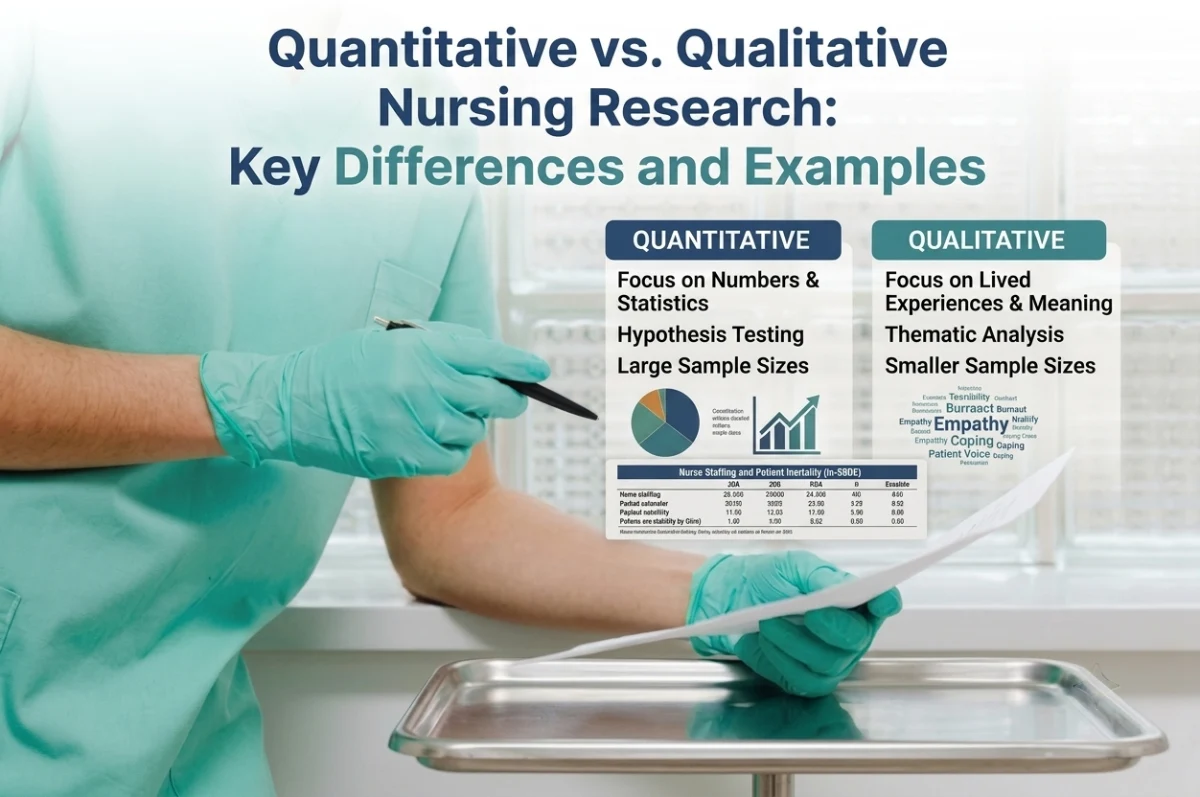
Every nursing student hits the same wall during proposal writing. You can define both research types if someone asks in class, and the theory makes sense on paper. But once you sit down to write your own question, something doesn’t click. That small hesitation usually turns into a bigger problem later, when the methodology section doesn’t match the question you started with.
This mix-up isn’t about a lack of preparation. Nursing topics often sit right on the line between the two approaches, so the confusion is reasonable. A question about patient recovery, for instance, could be studied through numbers or through interviews, and both would work. What matters is knowing how to pick the right one for your specific proposal, and that’s exactly what this post will walk you through.
Quantitative vs Qualitative: Where the Confusion Starts
Most nursing students already know that one approach deals with numbers and the other deals with experiences. What trips people up is applying that knowledge to their own topic. A question like “Does patient education reduce readmission rates?” sounds straightforward, but it can be studied numerically using hospital records or patient interviews about what actually influenced their understanding. Both are valid starting points, yet they lead to completely different qualitative research nursing designs.
This is usually where proposals go sideways. Students pick a topic, assume the approach is obvious, and only realize halfway through writing that their question doesn’t match their method. Getting clear on what separates the two early on saves rework later. The next few sections break down what each approach actually looks like in practice, starting with the numbers side first.
What Quantitative Nursing Research Actually Measures
It Starts With a Number
Quantitative research answers questions you can count. How many patients developed infections after a specific procedure? How often did medication errors occur on a particular shift? How long did the average patient wait before being seen? These aren’t opinions or impressions. They’re figures pulled from records, charts, and structured data collection.
Why Hospitals Rely on It
Hospital administrators and policy teams don’t make large decisions based on how staff feel about a process. They need quantifiable evidence, something they can measure, compare, and act on with confidence. If readmission rates drop after a new discharge protocol, that number becomes the justification for keeping the protocol in place.
What a Published Study Looks Like
If you open a typical quantitative nursing research article, the pattern is usually the same. A clear hypothesis, a defined sample size, statistical testing, and a results section built almost entirely around data tables and percentages. There’s very little room for interpretation because the numbers are meant to speak for themselves.
Qualitative vs Quantitative Nursing Research: Where Students Mix Them Up
Getting qualitative vs quantitative nursing research wrong usually happens at the question stage, not the writing stage. Students pick a topic they care about, then design a method that doesn’t actually match what they’re trying to find out.
A Common Mismatch
Here’s a real example. A student wants to study patient anxiety before surgery. They write a qualitative-sounding question, something like “what is the patient experience of pre-surgical anxiety,” but then design a survey using numeric rating scales from one to ten. The question asks about experience. The method only captures a number.
Signs Your Method Doesn’t Match Your Question
- Your question uses words like “feel,” “experience,” or “perceive,” but your tool only collects numbers
- Your question asks “how many” or “how often,” but your method involves open-ended interviews
- You’re combining both without a clear reason for doing so
This kind of mismatch is one of the most common issues supervisors flag during proposal review, and it almost always traces back to skipping a proper quantitative vs qualitative research comparison before choosing a method.
Quantitative vs Qualitative Research in Nursing at a Glance
Once both approaches make sense individually, a quick side-by-side recap helps everything click into place before you move on to picking one for your own proposal.
| Aspect | Quantitative | Qualitative |
| Data Type | Numbers, statistics, measurable values | Words, descriptions, personal accounts |
| Sample Size | Larger, often hundreds of participants | Smaller, often 10-30 participants |
| Common Tools | Surveys, structured checklists, and hospital records | Interviews, focus groups, open-ended questionnaires |
| Example Question | How many patients developed pressure ulcers this quarter | How do patients describe their recovery experience |
| Typical Output | Charts, percentages, and statistical results | Themes, patterns, and direct quotes from participants |
This isn’t meant to replace the explanations above. It’s just a fast way to check your understanding before moving into the actual decision-making part of your proposal, which is where things usually get tricky.
One Topic, Two Very Different Studies
Patient falls are a good example, because the same topic can lead to two completely different research papers depending on the angle you take.
A quantitative study would examine fall incidence rates, calculated per 1,000 patient days, and compare them across units or time periods. The output would be a number, something like “falls dropped by 18% after the new mobility protocol was introduced.” Clean, measurable, and easy to compare against other hospitals.
A qualitative study would take the same topic and go in a different direction entirely. Instead of counting falls, it would interview nurses about near-miss situations, asking what they noticed right before a fall almost happened. The output here isn’t a percentage. It’s a pattern, maybe several nurses mentioning the same warning signs that data alone would never capture.
Same topic, two completely different papers. Neither is wrong. They just answer different questions. In the quantitative vs qualitative debate, it is all about the approach and purpose of the paper that decides which research type is better.
Deciding Which Approach Fits Your Proposal
Read Your Own Question Carefully
The fastest way to figure this out is to look at how your question is phrased. Read it out loud and notice the verbs you’re using before deciding on a method.
The Two Question Types
Ask “how many” or “how often”?
If your question sounds like “how many patients experienced falls after a medication change” or “how often do night-shift nurses report fatigue,” you’re working with quantitative data. You’re measuring something.
Ask “how do patients feel” or “what is the experience of”?
If your question sounds like “how do patients feel about post-operative pain management” or “what is the experience of new nurses during their first year,” you’re working with qualitative data. You’re exploring something.
Matching this early is what keeps your nursing research proposal consistent from the question stage through to the methodology section, instead of needing a rewrite later.
Why This Matters Early
Supervisors notice quickly when a question and method don’t align, and fixing it after a draft is already written takes far more time than checking it upfront. A few minutes spent reading your own question closely can save weeks of revision down the line.
When the Line Isn’t Clear
Sometimes a topic genuinely doesn’t split cleanly between the two approaches. That’s normal, not a sign you’ve done something wrong. It usually means the topic needs a second pair of eyes before you commit to a direction, and that’s a normal part of the process, not something only students who are struggling need. A lot of students turn to coursework writing services at exactly this stage, not to hand off the work, but to get a second opinion on the structure before moving forward.
A few situations where this happens often:
- The topic naturally suits a mixed-methods design, combining numbers with patient interviews
- The deadline is close and there’s no time to second-guess the structure alone
- Feedback from a supervisor pointed to a mismatch, but it’s unclear how to fix it
Getting outside input can save more time than trying to sort it out alone, especially once a deadline is close. If the issue is specific to nursing, that review usually needs someone familiar with clinical research design rather than general academic writing. This is where nursing term paper writing services UK can help, particularly with tightening the research design section before submission. It’s less about handing off the work and more about catching structural issues early, while there’s still enough time to fix them properly.
FAQs
Q1: What is the difference between qualitative and quantitative research in nursing
Quantitative research uses numbers and measurable data, like infection rates. Qualitative research focuses on personal experiences, gathered through interviews, to explain the reasoning behind those numbers.
Q2: Can a nursing research proposal use both quantitative and qualitative methods?
Yes, this is called mixed-methods research. It works when a topic needs both measurable data and a deeper understanding of patient or staff experiences.
Q3: Which method is easier for a first-time nursing student to design?
Quantitative research is usually more straightforward for beginners, since the structure is more defined. Qualitative research takes more practice with interviewing and analysis.
A Quick Way to Check Your Research Design
Before you move forward, it’s worth running your proposal through one last check. It only takes a few minutes, but it catches most of the mistakes supervisors flag later. Read your question again and see if it asks “how many” or “how do patients feel,” then check whether your method actually matches that. If you’re collecting numbers for a question about experience, or the other way around, that’s the gap to fix now rather than after the draft is written. It also helps to glance at your literature review to see which direction it already leans, since that often points to the approach that best fits. And if you’re combining both methods, make sure there’s a clear reason behind it, not just uncertainty about which one to pick.
Getting this right early doesn’t just make your proposal stronger. It makes the rest of the writing process considerably easier, since every section from that point on builds on a foundation that actually holds together.

Elizabeth Hall a professional academic writer at Nursing Writers UK and an experienced nurse with a wealth of knowledge and experience in nursing practice․ With a wide-ranging academic background, she is well placed to support undergraduate and post-graduate students as they study at universities across the UK, providing evidence-based assignments, case studies, reflective reports and research projects according to current clinical and academic standards․ Elizabeth is committed to academic integrity, clarity, and precision in all work․ In her classes, she seeks to develop nursing students’ critical thinking skills, paper organization, and academic writing to a professional level of competence and scholarly quality․